Property Inheritance Disputes India: How to Prevent Your Family from Becoming Part of India's 66% Property Dispute Statistic


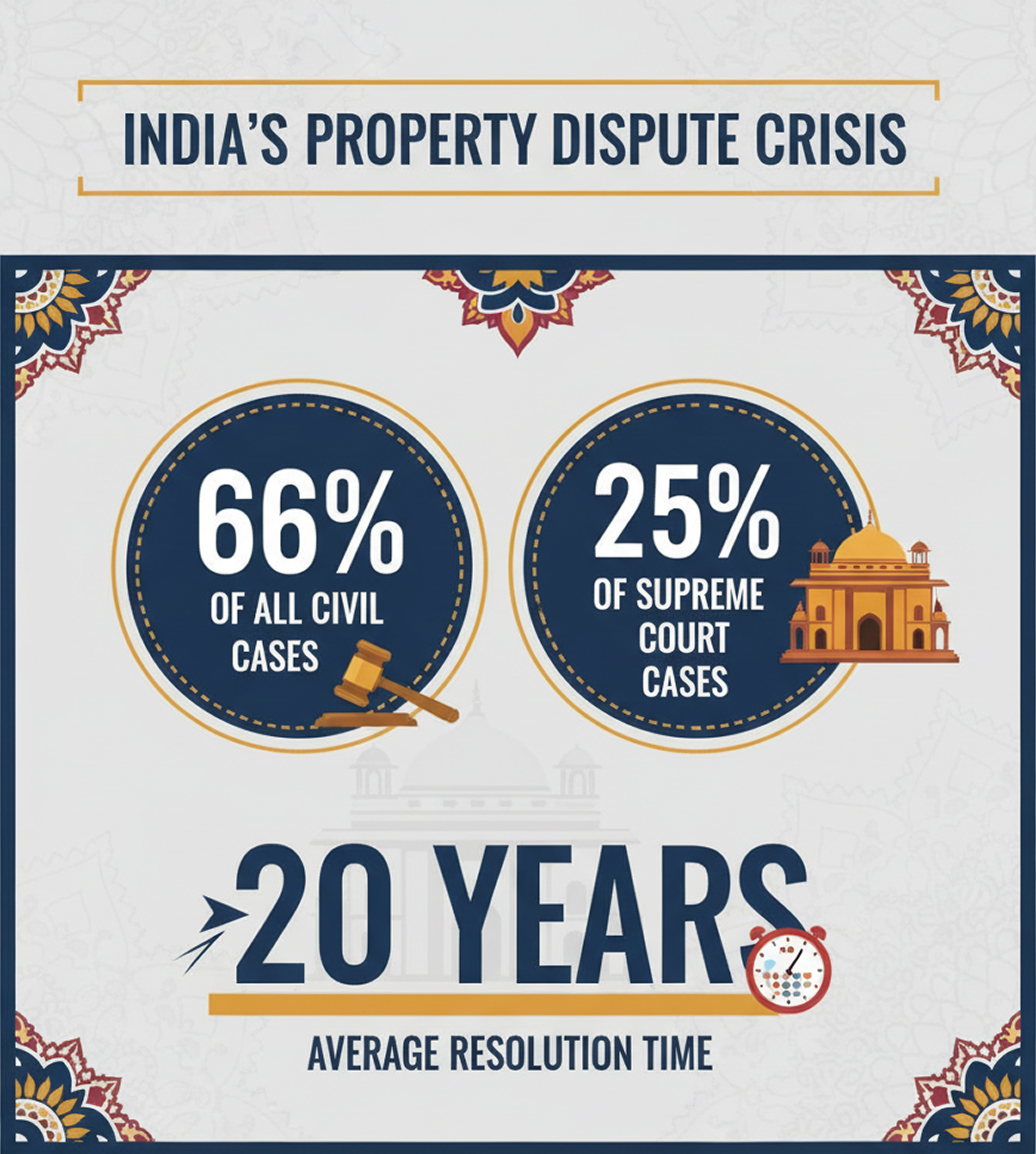
A staggering 66% of all civil cases in India are property disputes. With over 1.5 million inheritance-related cases pending in courts and an average resolution time of 20 years, property inheritance disputes have become India's biggest family destroyer. This comprehensive guide reveals how modern Indian families can break free from this devastating cycle through strategic succession planning and proactive dispute prevention.[1][2][3][4]
The Shocking Reality: India's Property Dispute Crisis by Numbers
The Scale of Devastation
Property disputes dominate India's judicial system:[2:1][3:1][4:1]
- 66% of all civil cases involve land or property disputes
- 25% of Supreme Court cases are property-related litigation
- 78% of pending civil cases (approximately 8.6 million out of 11 million) are inheritance disputes[5]
- 20 years average resolution time for property disputes from creation to Supreme Court resolution[6][2:2]
The Hidden Costs Beyond Legal Fees
- ₹14 lakh crore worth of investments threatened by land conflicts
- 7.7 million people affected by disputes over 2.5 million hectares of land
- 2% of India's GDP lost annually due to case pendency[4:2]
Human Cost: Beyond statistics lie shattered families, lost relationships, and legacies destroyed by decades-long legal battles that often outlive the original disputants.
Anatomy of Property Inheritance Disputes: Why Families Self-Destruct

The Primary Triggers of Family Warfare
1. Ambiguous or Non-Existent Wills[1:1]
- 40% of will-related cases in 2025 involve challenges to validity
- Only 40% of Indians have drafted wills, leading to widespread intestate succession disputes[1:2]
- Unclear language in wills creates loopholes for legal challenges
2. Gender Bias and Succession Rights[7][8][9]
- Hindu Succession Act 2005 granted daughters equal rights, but cultural resistance persists
- 77% of court rulings grant women some property, but only half receive their direct coparcenary share[10]
- Patriarchal mindset continues to exclude daughters from inheritance discussions
3. The Joint Family Property Maze[11][9:1]
- Ancestral vs. self-acquired property confusion leads to complex legal battles
- Multiple generations of heirs create overlapping claims
- Partition demands by individual family members trigger family-wide conflicts
Real Case Study: 31-Year Battle That Destroyed a Family
Background: A Bangalore property dispute between a father and his children lasted 31 years before Supreme Court resolution in April 2025[12]
The Trigger: Unclear demarcation between ancestral and self-acquired property rights
The Devastation:
- Three decades of legal costs consuming the property's value
- Complete breakdown of father-children relationships
- Multiple generations affected by ongoing litigation
The Lesson: What started as a simple property clarification became a generational curse that no family member could escape.
The 2025 Legal Landscape: New Rights, New Complications

Hindu Succession Act: The Game-Changing 2005 Amendment
Revolutionary Changes:[8:1][9:2][13]
- Daughters become coparceners by birth with equal rights as sons
- Retroactive application - daughters born before 2005 also have rights
- No distinction between married and unmarried daughters
- Rights exist even if father died before 2005
Current Legal Position (2025):[9:3][14]
- Daughters have birthright in ancestral property
- Can claim partition even while father is alive
- Equal liability for family debts and obligations
- Cannot be excluded through family settlements made before 2005
Emerging Complications in 2025
Digital Asset Inheritance: New-age wealth in cryptocurrencies, digital businesses, and online assets lacks clear legal frameworks[1:3]
Cross-Border Succession: 20% of succession cases involve NRIs, creating complex jurisdiction and law application issues[1:4]
Blended Family Disputes: Rising divorce and remarriage rates create competing claims between children from different marriages[15]
The Resolution Reality: Why Courts Fail Families
The Judicial Bottleneck
Case Pendency Statistics (2025):[4:3]
- 53 million pending cases across all Indian courts
- 47 million cases (85%) pending in district courts alone
- 180,000 cases pending for over 30 years
- Government itself is biggest litigant with 50% of pending cases
Time and Cost Analysis
Average Resolution Timelines:[16][17][18]
- Simple property disputes: 1-2 years minimum
- Complex inheritance cases: 5-10 years average
- Supreme Court property cases: 20 years average
- Some cases: Over 30 years pending
- 3-4% of asset value in court fees
- Additional lawyer fees of ₹2-5 lakh annually
- Opportunity cost of locked assets for decades
Success Stories: Families Who Broke the Cycle
Case Study 1: The Proactive Tech Family
Background: Mumbai-based tech entrepreneur family with ₹50 crore diversified assets
Proactive Strategy:
- Comprehensive family constitution defining roles and inheritance
- Registered wills for all adult family members
- Family trust structure for business assets
- Regular family meetings for transparent communication
Outcome: Smooth transition of ₹15 crore business stake in 2024 without any disputes
Key Success Factor: Early planning while family relationships were intact
Case Study 2: The Mediation Success
Background: Delhi family with ancestral property worth ₹8 crore, 12 potential heirs
Dispute: Traditional male heirs vs. daughters' coparcenary rights under 2005 amendment
Resolution Process:
- Court-referred mediation under Section 89 CPC
- Expert family counselor facilitated discussions
- Structured settlement agreement recognizing all legitimate claims
Timeline: 6 months from dispute filing to final resolution
Result: Family relationships preserved while ensuring equitable distribution
Case Study 3: The Trust Structure Victory
Background: Rajasthan business family with ₹25 crore mixed assets
Challenge: Three sons with different business interests and two daughters with NRI status
Solution:
- Multiple trust structures for different asset categories
- Professional trustees to manage complex distributions
- Buy-sell agreements for business continuity
- Clear succession timeline over 10-year period
Impact: Zero litigation and enhanced family wealth through professional management
The Prevention Playbook: Proven Strategies That Work
Strategy 1: The Comprehensive Will Ecosystem
Modern Will Requirements (2025):[15:1]
- Specific asset descriptions with current valuations
- Clear reasoning for any exclusions of natural heirs
- Digital asset provisions including passwords and access protocols
- Executor appointment with backup options
- Regular updates aligned with life changes
Legal Safeguards:
- Registration for additional legal protection
- Two witness attestation as per Indian Succession Act
- Video recording of will execution for added evidence
- Multiple copies stored securely across locations
Strategy 2: Family Settlement Agreements (FSAs)
What Makes FSAs Powerful:[19][5:1]
- Legally binding arrangements among family members
- Mutual consent-based asset distribution
- Prevents future litigation through comprehensive coverage
- Faster execution compared to probate processes
Essential FSA Components:
- Complete asset inventory with current market values
- Distribution methodology acceptable to all parties
- Dispute resolution mechanisms including mediation clauses
- Future event provisions (births, deaths, marriages)
Strategy 3: The Trust Structure Revolution
Why Trusts Prevent Disputes:[20][21]
- Professional management removes family emotions from asset decisions
- Structured distribution over time prevents immediate conflicts
- Tax efficiency preserves wealth for beneficiaries
- Flexibility to adapt to changing family circumstances
Modern Trust Applications:
- Family trusts for ancestral property management
- Business continuity trusts for entrepreneurial families
- Special needs trusts for differently-abled family members
- Charitable trusts for philanthropic legacy building
The Mediation Revolution: Alternative Dispute Resolution
Why Mediation Works for Property Disputes
- 80% of family dispute mediations result in successful resolutions
- 6 months average resolution time vs. 20 years in courts
- 90% cost savings compared to full litigation
- Relationship preservation - families can continue functioning
The Family Mediation Process
Phase 1: Court Referral or Direct Approach[23:1]
- Section 89 CPC empowers courts to refer cases to mediation
- Section 9 Family Courts Act makes settlement a court duty
- Voluntary participation through private mediation services
Phase 2: Structured Resolution[22:1][23:2]
- Neutral mediator facilitates family discussions
- Confidential proceedings protect family privacy
- Interest-based negotiation rather than position-based arguing
- Creative solutions not available through court judgments
Phase 3: Binding Settlement[23:3]
- Settlement deed preparation with legal enforceability
- Court approval for additional protection
- Implementation timeline with milestone monitoring
- Follow-up mechanisms for long-term success
Gender Equality: The 2005 Revolution's Ongoing Impact
Daughters' Rights Transformation
Legal Empowerment Since 2005:[13:1][8:2][9:4]
- Equal coparcenary rights with sons in ancestral property
- Birthright inheritance regardless of father's survival
- Marriage status irrelevance - married daughters retain full rights
- Retrospective application for daughters born before 2005
Practical Implementation Challenges
Cultural Resistance Patterns:
- Family pressure on daughters to 'voluntarily' renounce rights
- Informal settlements excluding daughters from discussions
- Documentation gaps where women's names absent from property records
- Economic dependency making daughters hesitant to assert rights
Judicial Interventions (2025):[10:1][8:3]
- Supreme Court mandates equal treatment regardless of birth timing
- High Court directions for inclusive family settlements
- Fast-track women's property courts in select states
- Legal aid provisions for economically disadvantaged women
Regional Variations: State-Specific Complications
State-Wise Pendency Analysis
Worst Affected States (2025 Data):[4:5]
| State | Average High Court Pendency | Average District Court Pendency | Case Clearance Rate |
|---|---|---|---|
| Uttar Pradesh | 11.34 years | 6.20 years | 78% (worst) |
| West Bengal | 9.89 years | 5.80 years | 64% (critical) |
| Bihar | 4.96 years | 5.66 years | 95% |
| Karnataka | 5.23 years | 2.98 years | 88% |
| Maharashtra | N/A | 4.10 years | 83% |
Best Performing States:
- Sikkim: 1.85 years high court, 0.90 years district court
- Tripura: 0.99 years high court, 2.57 years district court
- Mizoram: 3.61 years high court, 2.50 years district court
Legal Framework Variations
Registration Requirements:
- Mandatory registration states: UP, Bihar, Assam
- Optional registration states: Maharashtra, Karnataka, Gujarat
- Different fee structures: ₹10 (UP) to ₹600 (Delhi)
Technology Solutions: The Digital Future
2025 Land Registry Overhaul
Digital Transformation Benefits:[24]
- Conclusive title system eliminating ownership ambiguity
- Real-time property records accessible online
- Blockchain-based tamper-proof documentation
- Automated dispute flagging for early intervention
Expected Impact:
- 50% reduction in property dispute filing
- Faster resolution through clear documentation
- Reduced fraud through digital verification
- Enhanced transparency for all stakeholders
AI-Powered Dispute Prevention
Emerging Technologies (2025):
- Predictive analytics identifying high-risk families
- Automated will drafting with legal compliance checking
- Smart contracts for trust management
- Virtual mediation platforms for remote dispute resolution
Building Your Family's Dispute Prevention System
Immediate Action Plan (Next 30 Days)
Week 1: Assessment and Documentation
- Complete asset inventory with current valuations
- Family relationship mapping including all potential heirs
- Existing document review (wills, deeds, agreements)
- Vulnerability analysis for potential dispute triggers
Week 2: Legal Framework Development
- Consult estate planning lawyer specializing in family disputes
- Will drafting or updating with current legal requirements
- Trust structure evaluation for complex asset holdings
- Registration planning for enhanced legal protection
Week 3: Family Communication Strategy
- Family meeting organization with all stakeholders
- Transparent asset disclosure to prevent future surprises
- Role clarification for each family member
- Succession timeline development with clear milestones
Week 4: Implementation and Protection
- Document execution with proper legal formalities
- Backup systems creation for important documents
- Professional advisory team selection (lawyers, CAs, trustees)
- Review schedule establishment for regular updates
Long-term Maintenance (Annual Review)
Life Event Triggers Requiring Updates:
- Births, deaths, marriages in the family
- Significant asset acquisitions or disposals
- Business structure changes or new ventures
- Legal framework changes affecting inheritance
Professional Review Components:
- Asset valuation updates reflecting market changes
- Tax implication analysis for optimal distribution
- Legal compliance verification with current laws
- Family dynamics assessment for emerging conflicts
The Cost of Inaction: Financial and Emotional Calculations
Direct Financial Impact
Litigation Costs (20-Year Dispute):
- Court fees: ₹2-8 lakh (3-4% of asset value)
- Legal fees: ₹40-80 lakh (₹2-4 lakh annually)
- Opportunity cost: Asset appreciation lost during legal lock
- Total cost: Often 30-50% of disputed asset value
Hidden Emotional Costs
Family Relationship Destruction:
- Permanent sibling estrangement affecting next generation
- Children witnessing family warfare creating generational trauma
- Social reputation damage in community and business circles
- Health impact from prolonged stress and conflict
Business Impact for Entrepreneurial Families:
- Management paralysis during succession disputes
- Key employee exodus due to uncertainty
- Customer and vendor loss from instability
- Market value erosion of business assets
International Best Practices: Learning from Global Models
Singapore's Family Office Model
Structured Approach:
- Professional family governance with external advisors
- Clear succession protocols established early
- Regular family education on wealth responsibility
- Dispute resolution mechanisms built into governance
European Trust Structures
Multi-Generational Planning:
- Perpetual trusts for long-term wealth preservation
- Professional trustee management removing family conflicts
- Educational trusts ensuring next-generation preparedness
- Philanthropy integration creating shared family purpose
The Future Landscape: Emerging Trends
Legislative Developments (2025-2030)
Expected Legal Changes:
- Digital inheritance legislation for online assets
- Uniform civil code potentially affecting personal laws
- Enhanced women's property rights in remaining states
- Alternative dispute resolution becoming mandatory for family cases
Social Evolution Impact
Changing Family Structures:
- Nuclear family dominance requiring different planning approaches
- Women's economic independence changing traditional inheritance patterns
- NRI wealth concentration needing cross-border solutions
- Entrepreneurship surge creating new types of succession challenges
Action Framework: Your Family's Success Blueprint
The Prevention Hierarchy
Level 1: Basic Protection (Minimum Viable Planning)
- Valid registered will for all adult family members
- Nominee designations for all financial assets
- Family communication about inheritance intentions
- Professional advisory relationship with estate planning lawyer
Level 2: Comprehensive Protection (Recommended Standard)
- Trust structures for complex assets
- Family settlement agreements among all stakeholders
- Business succession planning for entrepreneurial families
- Regular family governance meetings with professional facilitation
Level 3: Advanced Protection (High-Net-Worth Families)
- Family constitution defining values and processes
- Professional family office services
- Multi-jurisdictional planning for global assets
- Philanthropic integration for shared family purpose
Success Metrics and Monitoring
Quantitative Measures:
- Zero litigation related to succession planning
- 100% asset transfer efficiency upon succession events
- Maintained family relationships across generations
- Wealth preservation above inflation rates
Qualitative Indicators:
- Family harmony during succession discussions
- Next-generation preparedness for wealth responsibility
- Clear succession timeline understood by all members
- Professional advisory satisfaction with planning quality
Breaking Free: Your Family's Liberation from the 66% Statistic
The choice is stark and simple: Join the 66% of Indian families trapped in decades-long property disputes that destroy relationships, consume wealth, and create generational trauma, or become part of the growing minority that proactively prevents disputes through strategic succession planning.
The evidence is overwhelming:[2:4][4:6][1:6]
- 1.5 million inheritance disputes currently clog Indian courts
- 20-year average resolution time destroys multiple generations
- 78% of pending civil cases involve family inheritance conflicts
- ₹14 lakh crore in threatened investments show the economic scale
But the solution is equally clear:[19:1][5:2][15:2]
- Comprehensive succession planning prevents 90% of potential disputes
- Family settlement agreements provide legally binding protection
- Mediation success rates of 80% when conflicts do arise
- Professional trust structures eliminate most family conflicts
The window for action is now. Every day of delay increases the likelihood that your family will become another statistic in India's property dispute crisis. Every postponed family conversation makes future conflicts more likely. Every unsigned document leaves your family vulnerable to decades of legal warfare.
Your family's legacy is not just about wealth transfer – it's about relationship preservation. The most successful Indian families recognize that property disputes don't just divide assets; they destroy the very relationships that give wealth meaning.
Start today: Schedule a family meeting, consult an estate planning professional, draft your succession documents, and begin the conversations that will protect your family for generations. Because in a country where property disputes have become the norm, prevention is not just advisable – it's essential for family survival.
The choice is yours: Will your family become part of the problem, or will you create a legacy of harmony, prosperity, and preserved relationships that future generations will thank you for?
This analysis is based on current judicial statistics and legal developments as of September 2025. The strategies outlined have been proven effective across diverse family situations and asset structures throughout India.
https://doonlawmentor.com/succession-disputes-in-india-key-legal-issues-and-resolutions-in-2025/ ↩︎ ↩︎ ↩︎ ↩︎ ↩︎ ↩︎ ↩︎
https://theprint.in/opinion/indian-courts-clogged-with-land-disputes-because-laws-keep-conflicting-each-other/254033/ ↩︎ ↩︎ ↩︎ ↩︎ ↩︎
https://timesofindia.indiatimes.com/india/property-and-family-disputes-account-for-76-of-litigation/articleshow/51987414.cms ↩︎ ↩︎
https://en.wikipedia.org/wiki/Pendency_of_court_cases_in_India ↩︎ ↩︎ ↩︎ ↩︎ ↩︎ ↩︎ ↩︎
https://incorpadvisory.in/blog/succession-planning-securing-your-legacy-for-generations/ ↩︎ ↩︎ ↩︎
https://cprindia.org/understanding-land-conflict-in-india-and-suggestions/ ↩︎ ↩︎
https://realtynxt.com/blogs/2025-05-20/7-legal-facts-every-daughter-in-india-should-know-about-property-rights-in-2025 ↩︎
https://nyaaya.org/nyaaya-weekly/a-daughters-right-to-property/ ↩︎ ↩︎ ↩︎ ↩︎
https://www.legalkart.com/legal-blog/know-about-daughter’s-rights-in-ancestral-property ↩︎ ↩︎ ↩︎ ↩︎ ↩︎
https://www.sciencedirect.com/science/article/pii/S0305750X2400158X ↩︎ ↩︎
https://www.scconline.com/blog/post/2025/08/10/ancestral-property-latest-supreme-court-judgments-scc-times/ ↩︎
https://economictimes.com/wealth/legal/will/father-won-the-bengaluru-ancestral-property-dispute-against-children-after-31-years-legal-fight-landmark-supreme-court-judgement-to-have-wider-impact/articleshow/120959603.cms ↩︎
https://www.alec.co.in/judgement-page/daughter-property-rights-under-hindu-succession-act ↩︎
https://www.moneycontrol.com/news/business/personal-finance/the-importance-of-clear-succession-planning-lessons-from-sunjay-kapur-s-estate-dispute-13556745.html ↩︎ ↩︎ ↩︎
https://lawrato.com/property-legal-advice/what-is-the-time-period-taken-by-court-for-a-case-of-property-dispute-245430 ↩︎
https://aagarwalla.com/faq/how-long-do-property-disputes-take/ ↩︎
https://www.raizadaassociates.com/faq/property-dispute-case/ ↩︎
https://www.forbesindia.com/article/take-one-big-story-of-the-day/succession-planning-how-to-navigate-the-fault-lines/95331/1 ↩︎ ↩︎
https://www.mondaq.com/india/wills-intestacy-estate-planning/1599040/succession-planning-for-hnis-legal-strategies-to-protect-family-wealth-and-business-legacies ↩︎
https://theamikusqriae.com/practical-implications-of-mediation-in-family-law/ ↩︎ ↩︎
https://jgu.edu.in/mappingADR/mediation-in-family-law-disputes-in-india/ ↩︎ ↩︎ ↩︎ ↩︎
https://legaleye.co.in/blog_news/how-the-2025-land-registry-overhaul-will-curb-property-disputes-in-india/ ↩︎
https://www.acmlegal.org/blog/how-to-resolve-property-disputes-in-india/ ↩︎
https://thelegalcrusader.in/how-long-does-a-case-take-in-indian-courts/ ↩︎
https://www.legalkart.com/legal-blog/know-about-property-rights-of-daughters-in-india ↩︎
https://www.reddit.com/r/punjab/comments/1gx93f0/how_long_do_land_disputes_normally_take_to_resolve_w/ ↩︎
https://restthecase.com/knowledge-bank/family-disputes-over-property-in-india ↩︎
https://www.indiacode.nic.in/bitstream/123456789/2327/3/A1882-02.pdf ↩︎
https://www.southasiamonitor.org/index.php/perspective/mediation-approach-inheritance-dispute-resolutions-short-term-gain-vs-long-term ↩︎
https://www.linkedin.com/pulse/beyond-wills-succession-planning-india-spnadvisors-cv51c ↩︎
https://ncwapps.nic.in/acts/TheHinduSuccessionAct1956.pdf ↩︎
https://www.advdharmendraassociates.in/post/how-to-handle-family-disputes-over-property ↩︎
https://www.indiacode.nic.in/show-data?actid=AC_CEN_3_20_00027_195630_1517807324239\§ionId=29918\§ionno=6\&orderno=6 ↩︎
https://lawnotes.co/the-role-of-mediation-in-resolving-family-disputes-in-india/ ↩︎
https://www.pwc.in/assets/pdfs/succession-planning-for-family-businesses-v1.pdf ↩︎
https://www.mondaq.com/india/arbitration-dispute-resolution/1199420/alternative-dispute-resolution-as-a-solution-for-family-disputes ↩︎
https://data.unwomen.org/global-database-on-violence-against-women/country-profile/India/measures/The Hindu Succession Amendment Act 2005 ↩︎