The Ultimate After-Death Checklist for Indian Families: A Step-by-Step Guide

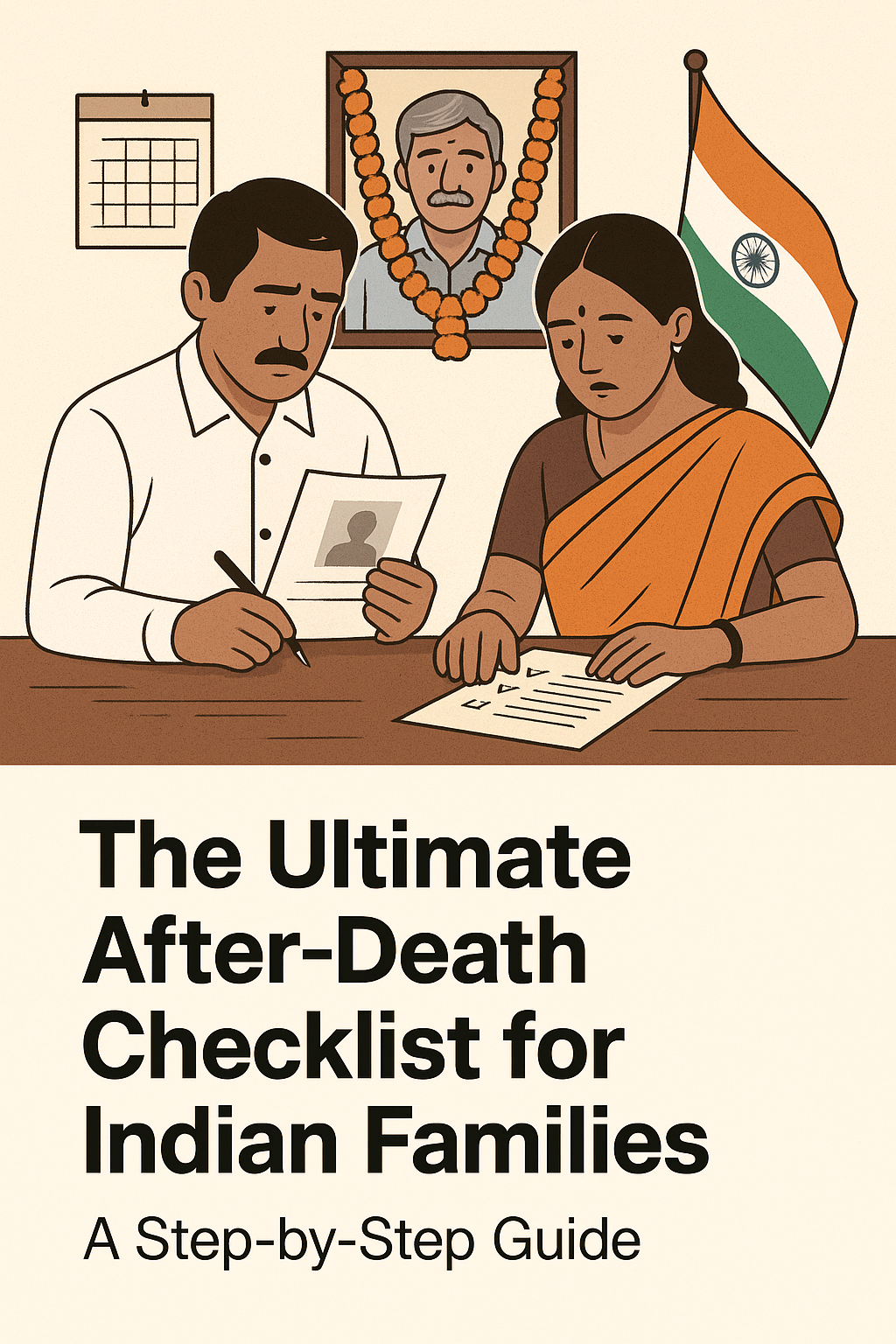
Losing a loved one is emotionally devastating, but for most Indian families, the deeper shock comes afterward—navigating the maze of legal, financial, and administrative tasks. Between grief and bureaucracy, families often spend months chasing paperwork, dealing with government offices, and trying to piece together information the deceased never documented.
This guide simplifies that journey. It gives you a clear, chronological checklist of what to do after someone passes away in India—from the first 24 hours to the final settlement of assets and claims.
Understanding India’s After-Death Administrative Burden
The hidden complexity most families face
India does not have a unified after-death process. Instead, families must deal with a fragmented system involving municipal bodies, banks, insurers, state revenue offices, EPFO, and sometimes courts. Most people are unprepared for this, which leads to delays, disputes, missed claims, and unclaimed assets.
The scale of the problem: India’s inheritance disputes and unclaimed assets
- 66% of all civil cases in India relate to property disputes.
- Over ₹1.24 lakh crore lies unclaimed across Indian financial institutions (EPFO, banks, insurance).
- Settling a typical Indian estate—especially when property and multiple accounts are involved—takes 6–24 months, depending on documentation and family coordination.
How this checklist is structured
This guide is broken down into six chronological phases:
- Phase 1: The First 24 Hours — Medical, municipal, and immediate steps
- Phase 2: The First Week — Funeral rites, certificates, and initial notifications
- Phase 3: Legal Foundations — Will, legal heirs, succession certificates
- Phase 4: Managing Assets and Liabilities — Bank accounts, EPFO, property, loans
- Phase 5: Digital and Documentation Cleanup — Passwords, online accounts, fraud prevention
- Phase 6: Moving Forward — Distribution, disputes, and planning your own legacy
Phase 1: The First 24 Hours — Immediate Steps
☐ Get the medical certificate of cause of death
If the death occurs at home, a registered medical practitioner must issue the certificate. If in hospital, the hospital issues it.
☐ Register the death within 21 days
Visit the local Municipal Corporation / Panchayat to apply for the Death Certificate. This is the single most important document for all claims.
Request 10–15 certified copies.
☐ Arrange for transportation and rites
Follow the deceased’s religious or personal wishes. Many Indian metro cities offer government-approved cremation/burial services with documentation support.
☐ Inform immediate family
Distribute responsibility—this helps with emotional management and logistics.
☐ Secure the home, valuables, and documents
Lock the premises. Identify key items:
- Property papers
- Bank passbooks
- ID proofs
- Will (if any)
- Insurance papers
- Keys to lockers and vehicles
Phase 2: The First Week — Funerals, Certificates & Notifications
☐ Check for a Will or Written Instructions
The presence—or absence—of a will dramatically changes the legal path.
Case Study: Searching for a Will in Indian Homes
Most Indian families store documents:
- In steel cupboards
- In files labeled generically
- With relatives
- In bank lockers
A well-documented digital vault (like AfterYou) removes this uncertainty and helps identify assets without guesswork.
☐ Apply for multiple Death Certificate copies
Banks, EPFO, insurers, property registrars, telecom operators, and even gas agencies require individual copies.
☐ Notify the deceased’s employer
Ask about:
- Pending salary
- Gratuity
- Provident Fund
- Pension
- Group insurance (GIS)
- Leave encashment
☐ Update or forward mail
Important government communication may still be delivered.
Phase 3: Legal Foundations — Will, Heirship, and Succession
Understanding Indian inheritance law
India has multiple inheritance frameworks depending on religion:
- Hindu Succession Act (Hindus, Sikhs, Jains, Buddhists)
- Indian Succession Act (Christians, Parsis)
- Muslim Personal Law
☐ If a Will exists
The executor may need to apply for:
- Probate (mandatory in Mumbai, Chennai, Kolkata; optional elsewhere)
- Letters of Administration (if no executor is named)
☐ If there is no Will
Legal heirs must apply for either:
- Legal Heir Certificate (for service benefits, pensions)
- Succession Certificate (for bank accounts, securities)
☐ Property transfer
Submit the death certificate and heirship documents to:
- Sub-registrar
- Housing society
- Municipal property tax office
Phase 4: Managing Financial Assets & Liabilities
☐ Create a complete asset inventory
Look for:
- Bank accounts (savings/current)
- Fixed deposits, RDs
- Demat & mutual fund folios
- EPF / PPF / NPS
- Insurance policies
- Real estate
- Business interests
- Gold & valuables
- Digital wallets (Paytm, PhonePe)
☐ EPFO and employer claims
EPFO requires:
- Form 20 (PF final settlement)
- Form 10D (pension)
- Form 5IF (EDLI insurance up to ₹7 lakh)
☐ Bank accounts
Submit:
- Death certificate
- KYC
- Succession documents
Banks will freeze accounts and release funds only through legal heir/survivor processes.
☐ Loans and liabilities
Heirs do not inherit unsecured debt.
But secured loans (home/vehicle) must be settled for asset transfer.
☐ Insurance claims
Life insurance in India pays out quickly (within 30 days) if documentation is complete.
Phase 5: Digital Cleanup — Passwords, Fraud & Online Footprint
☐ Protect against identity theft
India has rising cases of posthumous identity fraud.
Secure:
- PAN
- Aadhaar
- Phone number
- Bank accounts
- UPI handles
☐ Close or memorialize accounts
- Facebook memorialization
- Instagram memorialization
- Email closure
- UPI and wallet closures
- OTT subscriptions
☐ Locate digital assets
Crypto, digital gold, email, cloud drives, trading apps—these often go undiscovered without proper documentation.
AfterYou helps families avoid this uncertainty by storing everything securely in one place.
Phase 6: Moving Forward — Distribution & Planning Ahead
☐ Distribute personal belongings
This is often more emotional than financial distribution. Use a transparent process.
☐ Final tax return
File the deceased’s income tax return for the final year.
☐ Close the estate
Once all liabilities are paid, distribute assets per the will or succession law.
☐ Create your own AfterYou Plan
Most Indians say, “I’ll organize everything later,” but later rarely comes.
A proper plan avoids disputes, delays, and unclaimed assets.